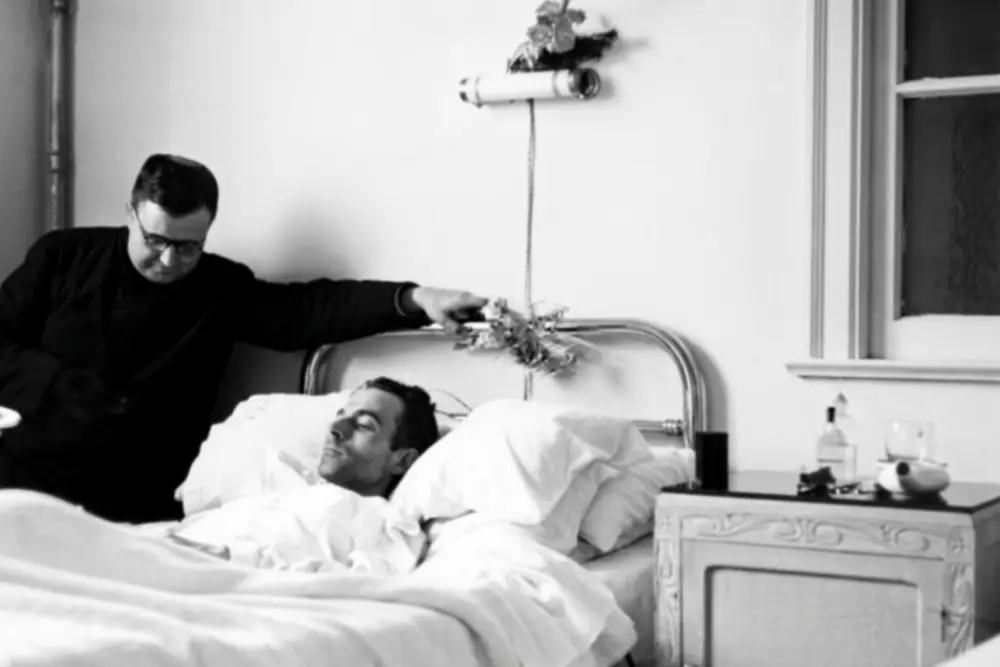
«Heal the sick!» (Mt 10:8). The Church has received this mission from the Lord and seeks to fulfill it through the medical and pastoral care she provides to the sick, as well as through the intercessory prayer with which she accompanies them in their time of need.
When a person becomes seriously ill or reaches an advanced age, many families wonder if it is time to request the Anointing of the Sick. However, there is still a belief that this sacrament is administered only to those who are about to die. The reality is quite different: the Anointing of the Sick is a sacrament of comfort, strength, and hope that the Church offers to those facing a serious illness or the frailty of old age.
Jesus Christ's mercy toward the sick and his numerous healings of people suffering from all kinds of ailments are a wonderful sign of his compassion for all who suffer in body and soul.
Through his Passion and death on the Cross, Jesus gave new meaning to suffering. Since then, this reality has shaped us in His image and united us to His redemptive mission. For Christians, illness and death can and should be means of becoming holy and being redeemed with Christ. The Anointing of the Sick exists to help us in this mission.
Christ’s presence during illness is a great source of comfort. He takes us by the hand and reminds us that we belong to Him, and that nothing can separate us from Him.
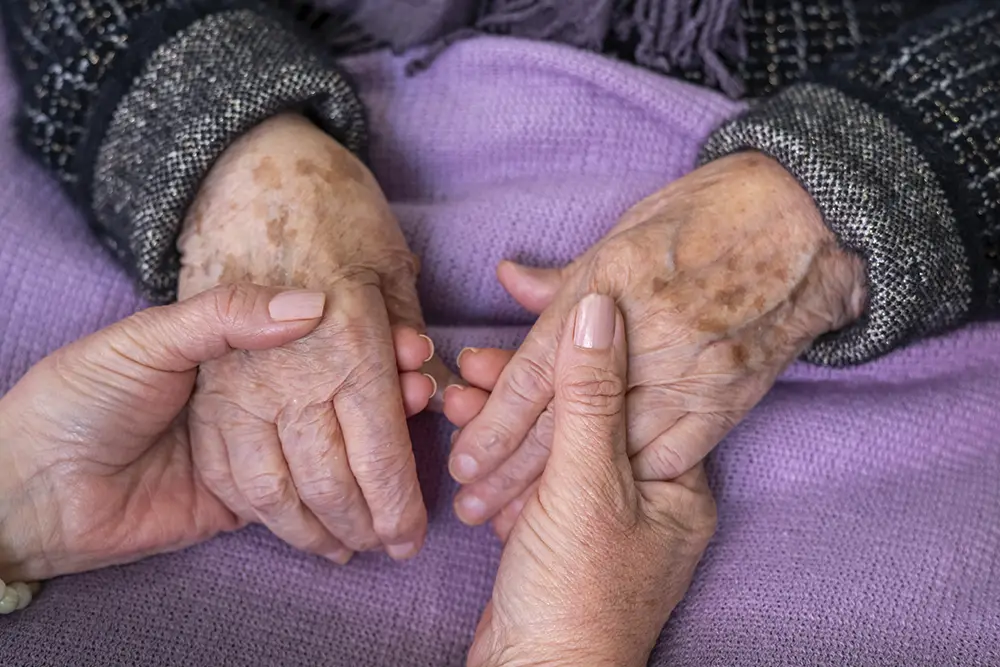
The parable of the Good Samaritan expresses the mystery celebrated in this sacrament: Jesus Christ draws near to those who suffer and comforts them with the oil of consolation and the wine of hope. He then takes them to the inn, which represents the Church, to whom Christ entrusts them. Christ taught his disciples to share his own special concern for the sick and the needy, and he entrusted them with the task of caring for them in his name through the sacrament of Anointing.
The Anointing of the Sick is a sacrament instituted by Jesus Christ, implied as such in the Gospel of Saint Mark. It was recommended to the faithful and promulgated by the Apostle James: «Is anyone among you sick? Call the elders of the church., »Let them pray over him and anoint him with oil in the name of the Lord. And the prayer of faith will save the sick person, and the Lord will raise him up; and if he has committed sins, they will be forgiven” (Jas 5:14–15).
The Church believes and professes that, among the seven sacraments, there is one sacrament specifically intended to comfort those afflicted by illness: the Anointing of the Sick. This sacrament helps us to live through these painful realities of human life with a Christian perspective: «In the Anointing of the Sick—as Extreme Unction is now called—we witness a loving preparation for the journey that will end in the Father’s house,» (San Josemaría Escrivá, It is Christ who passes, 80).
Over the centuries, the Anointing of the Sick was administered to those who were about to die; for this reason, it was called Extreme Unction. Likewise, the liturgy never ceased to pray for the sick.
Today we know that this sacrament is a sacrament of healing. It is a gift from God that helps to heal both the body and the spirit of the person who receives it. Through it, we ask the Lord for the health of the body, soul, and spirit of the Christian who is suffering from a serious illness or advanced old age.
«The primary grace of this sacrament is a grace of consolation, peace, and encouragement to overcome the difficulties inherent in serious illness or the frailty of old age. This grace is a gift of the Holy Spirit that renews trust and faith in God and strengthens one against the temptations of the evil one, especially the temptation to discouragement and anguish in the face of death […] This assistance from the Lord, through the power of his Spirit, is meant to lead the sick person to healing of the soul, but also to healing of the body, if such is God’s will. Furthermore, "if he has committed sins, they will be forgiven"» (CCC, 1520).
One should not think that this sacrament is intended only for those in danger of death; rather, it may also be received by those who are conscious and who consider it necessary.
Thus any Christian who is suffering from a serious illness, will receive a delicate operation or is very old can request that the sacrament of the anointing of the sick be administered to him or her. In the course of the same illness, the sacrament may be repeated if the illness worsens.
There is no limit on the number of times you can receive it and it's not a good idea to wait until the last minute.
The Church establishes that, if the sick person is unconscious, the sacrament of confession can be administered. Then the sacrament of anointing of the sick. If a seriously ill person dies without receiving this sacrament, the Church recommends administering it during the first hours after death.
«Only the Priests (bishops and presbyters) are ministers The Anointing of the Sick. It is the duty of pastors to instruct the faithful about the benefits of this sacrament. The faithful should encourage the sick to call a priest to receive this sacrament. »And let the sick prepare to receive it with a proper disposition, with the help of their pastor and the entire church community, which is invited to accompany the sick in a very special way with their prayers and fraternal care” (Catechism, 1516).
We all have to keep in mind that nowadays the seriously ill die alone in spite of being in modern hospitals. For this reason, the Christian work of those who have access to this reality is important. So that the hospitalized sick do not lack the means that give comfort and relief to the suffering body and soul, and among these means, in addition to the sacrament of Reconciliation and Viaticum, is the sacrament of the Anointing of the Sick.
Thus, just as the sacraments of Baptism, Confirmation, and the Eucharist form a unity known as «the sacraments of Christian initiation,» it can be said that Confession, Anointing, and the Eucharist—as viaticum—constitute, when the Christian life draws to a close, the sacraments that bring the earthly pilgrimage to a close.
"It helps us to broaden our vision in the face of illness and to know that we are not alone, that the priest and the Christian community support the sick and the suffering, Pope Francis.
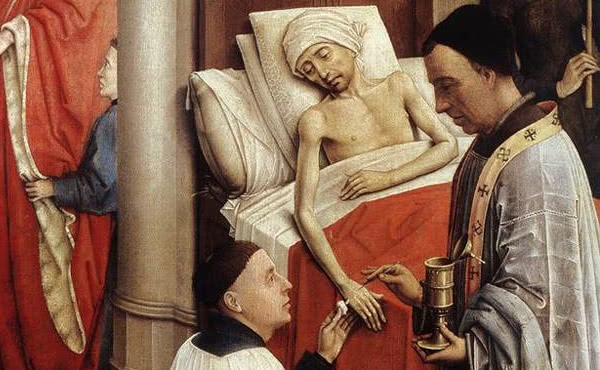
The subject of the Anointing of the Sick is every baptized person, who has reached the age of reason and is in danger of death due to a serious illness or old age accompanied by advanced senile weakness. The Anointing of the Sick may not be administered to the deceased.
To receive the fruits of this sacrament, the person must first be reconciled with God and with the Church—at least in desire—which is inseparably linked to repentance for one’s sins and the intention to confess them, whenever possible, in the sacrament of Penance. For this reason, the Church provides that, before the Anointing, the sacrament of Penance and Reconciliation be administered to the sick person.
The person must have the intention—at least a habitual and implicit one—to receive this sacrament. In other words: The patient must have an unwavering desire to die as Christians do., and with the supernatural aids intended for them.
Although the Anointing of the Sick may be administered to someone who has already lost consciousness, every effort should be made to ensure that it is received with awareness, so that the sick person may be better prepared to receive the grace of the sacrament. It must not be administered to those who remain obstinately unrepentant in manifest mortal sin (cf. CIC, can. 1007).
If a sick person who has received the Anointing of the Sick recovers, he or she may, in the event of a new serious illness, receive this sacrament again; and, during the course of the same illness, the sacrament may be repeated if the illness worsens (cf. CIC, can. 1004, 2).
Finally, it is important to keep in mind this guidance from the Church: «If there is any doubt as to whether the sick person has regained the use of reason, is suffering from a serious illness, or has already died, this sacrament is to be administered» (CIC, can. 1005).
Like all sacraments, the Anointing of the Sick is celebrated in a liturgical and communal way and takes place in the family, in the hospital or in the church, for a single sick person or for a group of sick people.
It is most appropriate that it be celebrated within the Eucharist, the memorial of the Lord's Passover. If circumstances permit, the celebration of the sacrament of Holy Unction may be preceded by the sacrament of Reconciliation and followed by the sacrament of Communion.
As for the sacrament of the Eucharist, it should always be the final sacrament of our earthly pilgrimage, the «viaticum» for the «passage» to eternal life. It is the seed of eternal life and the power of the resurrection, according to the Lord’s words. «Whoever eats my flesh and drinks my blood has eternal life, and I will raise him up on the last day» (Jn 6:54). Here, the Eucharist is the sacrament of the passage from death to life, from this world to the Father.
The Liturgy of the Word, preceded by an act of penance, opens the celebration. The words of Christ and the testimony of the Apostles arouse the faith of the sick person and the community to ask the Lord for the power of the Holy Spirit.
The priest is the one who will anoint the sick person with oil consecrated by the bishop on Holy Thursday. He anoints the sick person’s forehead and the palms of his or her hands, while speaking the words. «Through this Holy Anointing, and through His boundless mercy, may the Lord help you with the grace of the Holy Spirit, so that, freed from your sins, He may grant you salvation and comfort you in your illness» (Sacram Unctionem Infirmorum).
The primary grace of this sacrament is a grace of consolation, peace, and encouragement to overcome the difficulties inherent in serious illness or the frailty of old age. This grace is a gift of the Holy Spirit that renews trust and faith in God and strengthens one against the temptations of the evil one, especially against the temptation to despair and anxiety in the face of death.
This assistance from the Lord, through the power of His Spirit, is intended to lead the sick person to healing of the soul, but also to healing of the body, if such is God’s will. Furthermore, «if he has committed sins, they will be forgiven» (Jas 5:15).
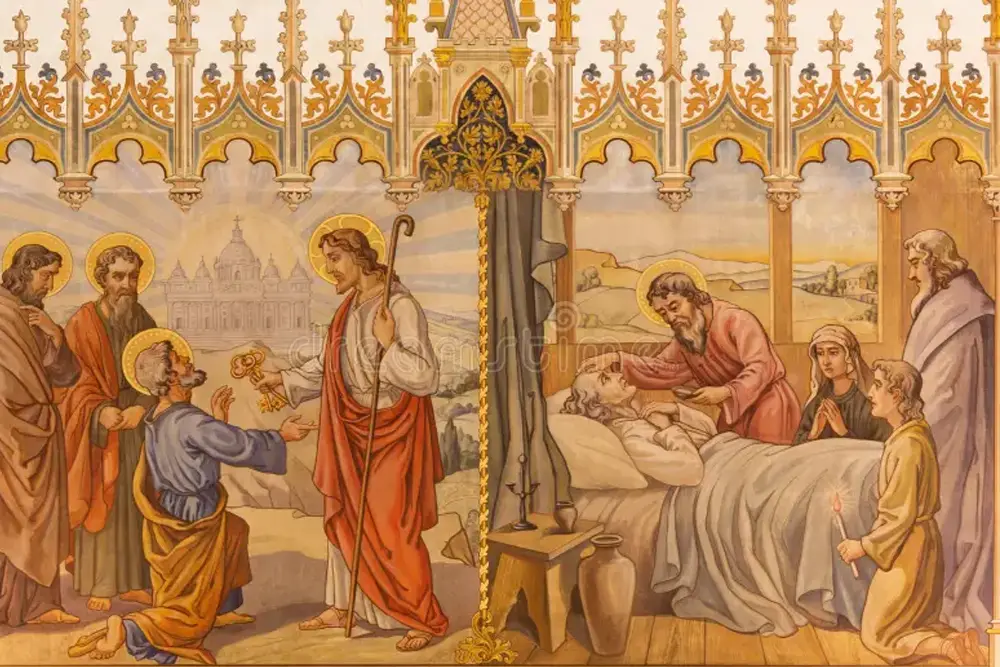
Through the grace of this sacrament, the sick receives the strength and the gift to unite more intimately with the Passion of Christ. Suffering, a consequence of original sin, takes on new meaning; it becomes a sharing in the work of Jesus.
In summary: the union of the sick person with the Passion of Christ, for their own good and that of the entire Church. Comfort, peace, and courage to bear the sufferings of illness or old age in a Christian manner. Forgiveness of sins if the sick person has been unable to obtain it through the sacrament of Penance. Restoration of physical health, if it serves spiritual well-being. And preparation for the passage into eternal life.
Bibliography
Table of Contents
 carf@fundacioncarf.orgLandline: +34 914 029 082Mobile: +34 638 078 51145 Conde de Peñalver Street.