In the founding document of the Anglican Ordinariates, created for those who desire full communion with the Catholic Church (cf. Benedict XVI, Const. Ap. Anglicanorum coetibus, 2009), it establishes its power to «to keep alive within the Catholic Church the spiritual, liturgical and pastoral traditions of the Anglican Communion.». This identity is recognized as a «precious gift» destined to nourish the faith of its members and as a spiritual richness to be shared with the entire ecclesial community (cf. section III).
A little more than a month ago, the Dicastery for the Doctrine of the Faith invited the bishops responsible for these Ordinariates to write down their experience of how they have received and integrated these elements, both cultural and religious, coming from the Anglican tradition. Their response has now been published (cf. Characteristics of the Anglican Heritage as Lived in the Ordinariates Established Under the Apostolic Constitution “Anglicanorum Coetibus”.”, 24-III-2016).
The bishops have affirmed that, despite the distances and the different places where they are settled (such as England and Scotland, Orlando, Australia and Micronesia), they are conscious of sharing an essential identity (a core share identity). «This shared identity has its origin in a common journey of following Christ that has brought them into full communion with the Catholic Church".
Therefore, they understand that, by entering the Catholic Church, they have brought with them that which already in 1970 St. Paul VI called a «precious patrimony of piety and customs» a "precious patrimony of piety and customs".» which the Church recognizes, as we have seen, as a precious gift not only for them but also to share with other Catholics.
Already in June 2024, Cardinal Victor Fernandez, from Westminster Cathedral (the main Catholic temple of England and Wales), called attention to the value of these Ordinariates in the perspective of inculturation:
«The existence of the Ordinariate [...] reflects a profound and beautiful reality about the nature of the Church and inculturation of the Gospel, as a rich English heritage. For the Church is one, and the Gospel is one, but in the process of inculturation, the Gospel is expressed in a variety of cultures. In this way, the Church takes on a new face [...] In this process, the Church not only gives, but is also enriched. For, as he taught St. John Paul II, Every culture offers positive values and forms that can enrich the way in which the Gospel is preached, understood and lived" (Apostolic Exhortation, "The Gospel is not only preached, but also understood and lived"). Ecclesia in Oceania, 2001, 16)».
The Ordinariate, said the Prefect of the Dicastery for the Doctrine of the Faith, represents a concrete expression of this reality: «In the case of the Ordinariate, the Catholic faith is inculturated among people who have lived the Gospel in the context of the Anglican Communion. By entering into full communion with the Catholic Church, the Catholic Church has been enriched. We can say, therefore, that each Ordinariate represents one of the faces of the Church, which, in this case, embraces certain elements of the rich history of the Anglican tradition: elements that are now lived out in the fullness of Catholic communion.».
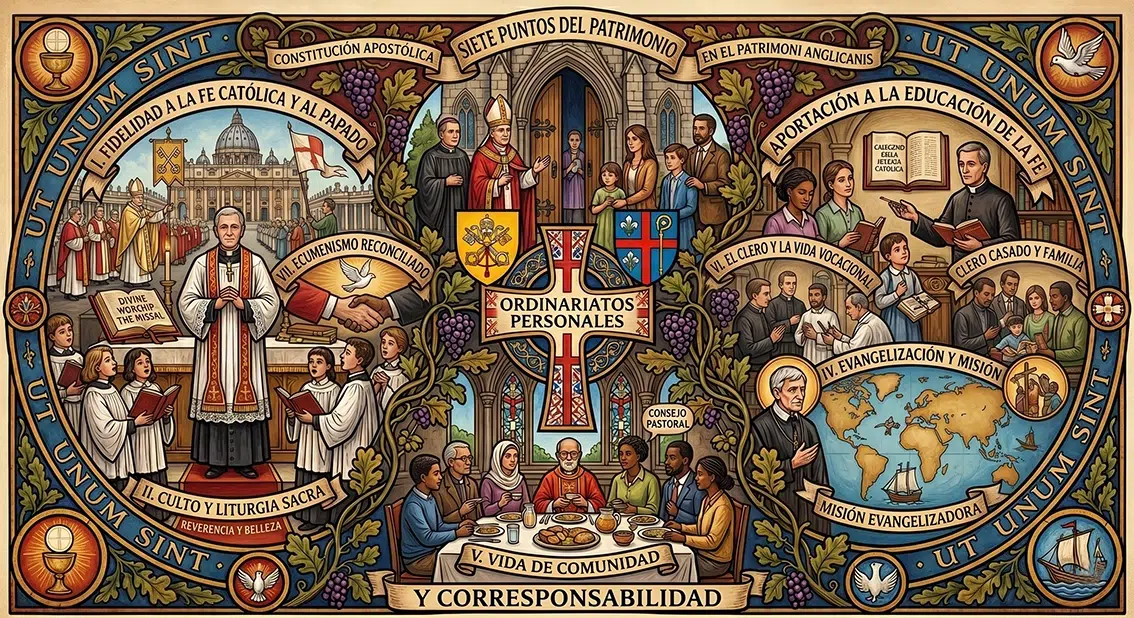
As we were saying, the most recent chapter of this history is the list that the bishops of the Anglican Ordinariates have drawn up, enumerating the traits that they consider characteristic of their spiritual and pastoral heritage. They identify in seven paragraphs those traits which, as we can see, constitute interesting suggestions for the education of the faith in the Catholic Church as a whole (cf. Characteristics, document cited). These characteristics, as we shall see, have much to do with St. John Henry Newman. With his figure and with his path towards the Catholic Church.
Participation, tradition, beauty
1. A distinctive “ecclesial ethos”. It is an ecclesial praxis characterized «by the broad participation of both clergy and laity in the life and governance of the Church.» This culture, they explain, «is intrinsically consultative and collaborative.» It is also characterized by the ability to welcome those who wish to enter into Catholic communion «while preserving the uniqueness of their spiritual history.».
Moreover, «it is centered on a living sense of tradition that seeks to remain faithful to what has been received, while recognizing the place of organic development». As can be seen, these are principles and criteria that are also valid for faith education, insofar as they mark a style of active participation in the life and mission of the Church.
2. Evangelization through beauty. Secondly, they emphasize «the importance of beauty, not as an end in itself, but insofar as it has the power to lead us to God; therefore, it possesses an inherent evangelizing power». For this reason, «divine worship, sacred music and sacred art» are understood both as means to lead us to communion with God and as instruments of mission.
«The beauty they convey is intended to draw individuals and communities to a full participation, body and soul, in the work of the Savior, who is the ‘image of the invisible God’ (Col 1:15) and the ‘radiance of [the Father's] glory’ (Heb 1:3).» In fact, liturgy and art are expressions of the “way of beauty” that today we consider essential in the education of the faith. This education includes, in addition to the intellectual aspect, the aesthetic and spiritual experience that facilitates the encounter with the Truth and Love of God.
Liturgy and life and social dimension
3. Direct approach to the poor: «In the Ordinariates,» your bishops point out, «the beauty of worship and holiness of life are embodied in the concrete realities of the neighborhood. This is understood as a reflection of a profoundly incarnated theology, which invites us to go out of divine worship to seek Jesus among the poor and the needy (cf. Mt 25:40). As a practical example, they evoke the fact that "the crowds that gathered in the streets of Birmingham for the funeral of Saint John Henry Newman were there not only because of his scholarship, but also because he was the priest who attended to their needs».
This is so, because the Incarnation leads to promote the dignity of each person and to engage in the social dimension of evangelization. And this must be promoted in education, in all places and in all ages of people.
4. Pastoral culture. Under this heading, they understand «a pastoral culture in which divine worship and daily life are deeply interconnected». In other words, the connection between liturgy and life is promoted. In this case it is specifically «a liturgical, almost monastic rhythm, inspired by the English spiritual tradition». They consider essential to this the communal recitation of the Divine Office, understood as the prayer of the whole People of God (cf. Ps 119:164; Eph 5:19). [cf. Sacrosanctum concilium, 100).
And they affirm that this characterizes how to «form and sustain parish communities». Indeed, and this enriches faith education which is education for faith professed and celebrated, lived and translated into prayer and praise of God, along with service to all.
Family and education
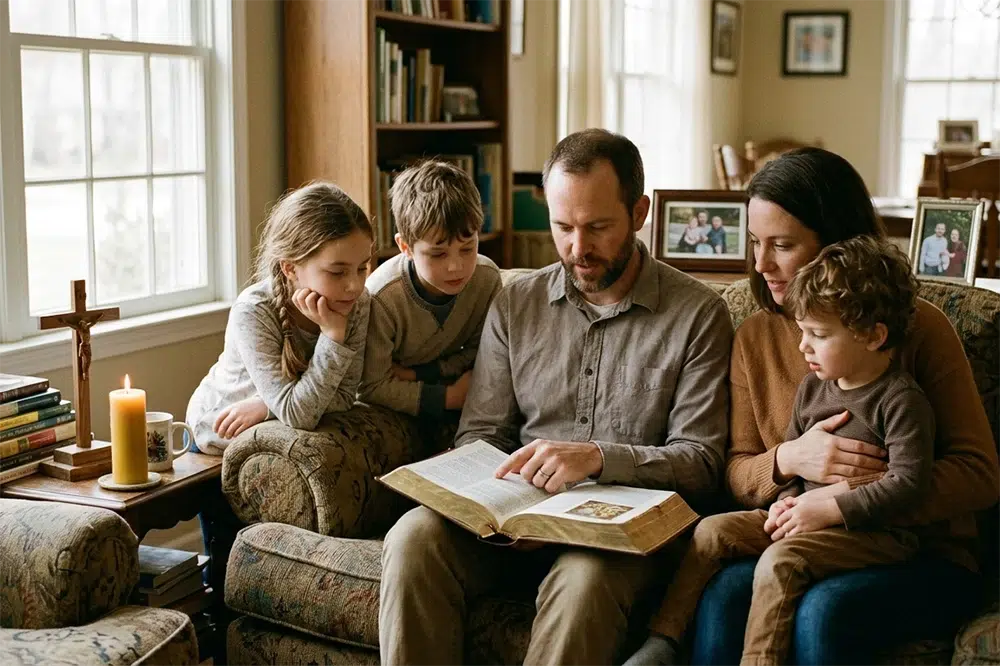
5. The family and the domestic church. Another aspect on which the bishops placed special emphasis is the importance of the family and its role as the «domestic church» (cf. Lumen gentium, 11) In fact, they pointed out that the shrine of Walsingham (dedicated to Our Lady as patroness of England) is called “the British Nazareth”. Just as Nazareth, according to St. Paul VI, is ‘the school of the Gospel’ (cf. Allocution, 5-I-1964) where we learn to observe, listen, meditate and understand the mystery of the Son of God in the bosom of the Holy Family, the Christian home is also the first place where faith is learned and lived.
At the heart of all this is «the appreciation of the sacrament of marriage and the role of parents as the primary educators of their children in the faith» (cf. Decl. Gravissimum educationis, 3). Hence, in the Ordinariates, parents are supported in this sacred responsibility of transmitting the faith to their children (cf. Dt 6:6-7; Joel 1:3) and families are accompanied in their joint growth in Christ.
In addition, «this vision leads to an organic approach to the training which focuses on the parish and the family, and which gives priority to the ongoing intellectual formation of all the members of the Body of Christ». All of this has a direct bearing on education in the faith.
Writing, preaching and personal care
6. Scripture and preaching: these bishops also pointed out that their patrimony includes «a solid tradition of preaching based on Scripture, recognizing that feeding people intellectually is an integral part of feeding their souls (cf. Mt 4:4)». Here the theme of beauty reappears: «The encounter with Christ in the splendor of the liturgy and in the proclamation of the Word are not to be understood as separate realities, but as two dimensions of the same encounter» (Sacrosanctum Concilium 7, 48-51 y Catechism of the Catholic Church 1088 y 1346).
They add that in the communities of the Ordinariate, this is lived «with a solid foundation in Tradition (especially in the Fathers of the Church) and with an appreciation of the role of reason in harmony with and at the service of faith». This relationship between Sacred Scripture and preaching in liturgical context connects with the traditional theme of the “two tables”: the Word (the Bible, The Eucharist (especially the Gospels and prayer) and the Eucharist.
7. Spiritual direction and the sacrament of Penance. Finally, they explained that they have inherited an appreciation of the importance of spiritual direction and the sacrament of Penance as elements of «the care of souls that gives priority to dedicating time to each person and accompanying them in their encounter with Christ, the Good Shepherd (cf. Jn 10:11-16; Lk 15:4-7)».
Incarnation, education and mission
In the concluding paragraphs of this document, the Dicastery for the Doctrine of the Faith notes that «if all these characteristics are considered together, one appreciates how fundamental the mystery of the Incarnation is to the patrimony preserved in the Ordinariates. The dignity of each person, the role of beauty, the richness of liturgical expression, concern for the poor and reverence for the domestic church all flow from this same source.».
This source is «ehe Son of God, Our only Savior (cf. Acts 4:12) and Mediator before the Father (cf. 1 Tim. 2:5), who, having become incarnate among us (cf. Jn. 1:14), having suffered for us (cf. 1 Pet. 2:21) and having risen from the dead, opened the way ‘so that we too might walk in newness of life’ (Rom. 6:4)».
Finally, as one could sense from reading the above, to the extent that this patrimony constitutes a way of welcoming and living the faith, «the clergy and faithful of the Ordinariates recognize that it is a living reality that looks to the future in the transmission of the faith to future generations (cf. Ps 22:30-31; 78:4-7; 102:18)». This is so, and a central aspect of this transmission of the faith is education, whether in the family, in the school (school teaching of religion) or catechesis and Christian formation in the parishes and ecclesial movements, etc.
The bishops of these Ordinariates conclude that this patrimony not only equips them with the means to welcome communities and individuals in full communion, but also «continues to shape their distinctive participation in the mission of the Church for the future,» growing organically and offering «a unique reflection of the face of the Church". Church and a distinctive contribution to the living richness of its identity as ‘one, holy, catholic and apostolic’».
Table of Contents
Mr. Ramiro Pellitero IglesiasProfessor of Pastoral Theology at the Faculty of Theology of the University of Navarra.
Published in Church and new evangelization.
Images elaborated with AI.
 carf@fundacioncarf.orgLandline: +34 914 029 082Mobile: +34 638 078 51145 Conde de Peñalver Street.