Mary was a simple young woman from Nazareth, far removed from the great centers of power of her time. Yet God set His eyes on her to entrust her with an extraordinary mission: to be the Mother of His Son, Saint Mary the Queen.
The Gospel of Saint Luke takes us right to that moment. The angel Gabriel appears before Mary and announces to her that she will conceive Jesus, who «will be called the Son of the Most High» and whose Kingdom will have no end. Mary, even without fully understanding what will happen, responds with complete trust in God: «Behold, I am the handmaid of the Lord; let it be done to me according to your word.».
That young woman who presents herself as a slave is the very one whom the Church regards and venerates as Queen of Heaven and Earth.
The answer is closely tied to Jesus Christ. Mary is Queen because she is the Mother of Jesus, King of the Universe.
The feast of St. Mary, Queen, was established by Pope Pius XII in 1954 to venerate the Virgin Mary as Queen, in the same way that the Church recognizes her Son as Christ the King.
Mary’s divine motherhood is, therefore, at the root of this dignity. As St. Josemaría explained, the graces and privileges with which God chose to adorn her also stem from this: she was conceived without sin, is full of grace, and was assumed body and soul into Heaven and crowned Queen of all creation.
But to understand what it really means to call Mary the Queen, we must move away from our usual idea of royalty.
When we think of a king or a queen, we may imagine power, wealth, or privileges. The kingship of Christ and Mary follows a completely different logic.
The source recalls a lesson from Benedict XVI: Jesus' kingship is interwoven with humility, service, and love. From a Christian perspective, being a king means, above all, serving, helping, and loving. And we find that same logic in Mary.
Her power is not directed toward herself. Mary puts it at the service of her children.
That is why Christians can approach her not only as Queen, but also as Mother. These two titles, far from contradicting each other, explain the unique relationship between the Virgin Mary and each Christian.
St. Josemaría encouraged us to live this with deep filial trust:
«Be filled with confidence: our Mother is the Mother of God, the Blessed Virgin Mary, Queen of Heaven and Earth.» (Forge, 273).
Recognizing Mary as Queen also leads us to trust in her intercession.
The Gospel shows how the Virgin Mary always leads us to her Son. St. Josemaría recalled the episode of the wedding at Cana: when that newlywed couple was in need, Mary intervened, and Christ performed the miracle. As a result, the disciples came to believe in Him.
Mary does not take the place of Christ: brings us closer to Him.
This certainty allows us to turn to her in times of difficulty, when our faith wavers, or even when we lack the words to pray. St. Josemaría advised us to invoke her with simplicity and trust, asking for her intercession so that we might once again experience God’s closeness.
Be filled with confidence: our Mother is the Mother of God, the Blessed Virgin Mary, Queen of Heaven and Earth. Forja, 273
Among the titles by which the Church invokes the Virgin Mary, there is one that is particularly significant: Queen of Peace, Regina pacis.
St. Josemaría recommended turning to her when anxiety takes hold of the heart, but also when facing family, professional, or social difficulties.
Devotion to Saint Mary the Queen thus takes on a very concrete dimension. It is not merely a matter of contemplating Mary crowned in Heaven, but of recognizing her as the Mother to whom we can turn in the ordinary circumstances of our lives.
It is especially beautiful that the Gospel reading chosen for the feast of Saint Mary, Queen, is the one about the Annunciation.
We don't find Mary sitting on a throne. We find her in Nazareth, listening to God.
The woman who will be crowned queen introduces herself by saying, «servant of the Lord». And that is precisely where we find one of the keys to understanding his greatness.
Mary opens herself to God, trusts in Him, and accepts His plans even when she cannot fully understand them. Her response—«Let it be done to me according to your word»—shows a radical trust that can serve as an example for every Christian.
Her life reminds us that God can be found in the simplicity and humility of everyday life.
Celebrate St. Mary the Queen, August 22 It is, therefore, much more than simply recalling one of the Virgin's titles.
It means contemplating Mary as the Mother of Christ and our Mother; as a Queen who serves, loves, and intercedes; and as an example of a life entirely open to God’s will.
St. Josemaría invited us to take part in this celebration with the trust of a child:
It is only right that the Father, the Son, and the Holy Spirit crown the Virgin as Queen and Lady of all creation. —“Make use of that power! And, with filial boldness, join in that heavenly celebration.”—“I crown the Mother of God and my own Mother with my purified miseries, for I have neither precious stones nor virtues.”—“Take heart!” Forja, 285
This August 22nd, we can take that invitation to heart and turn to Mary with confidence, sharing with her our needs, our joys, and also our difficulties.
Because the Queen of Heaven is, first and foremost, our Mother.
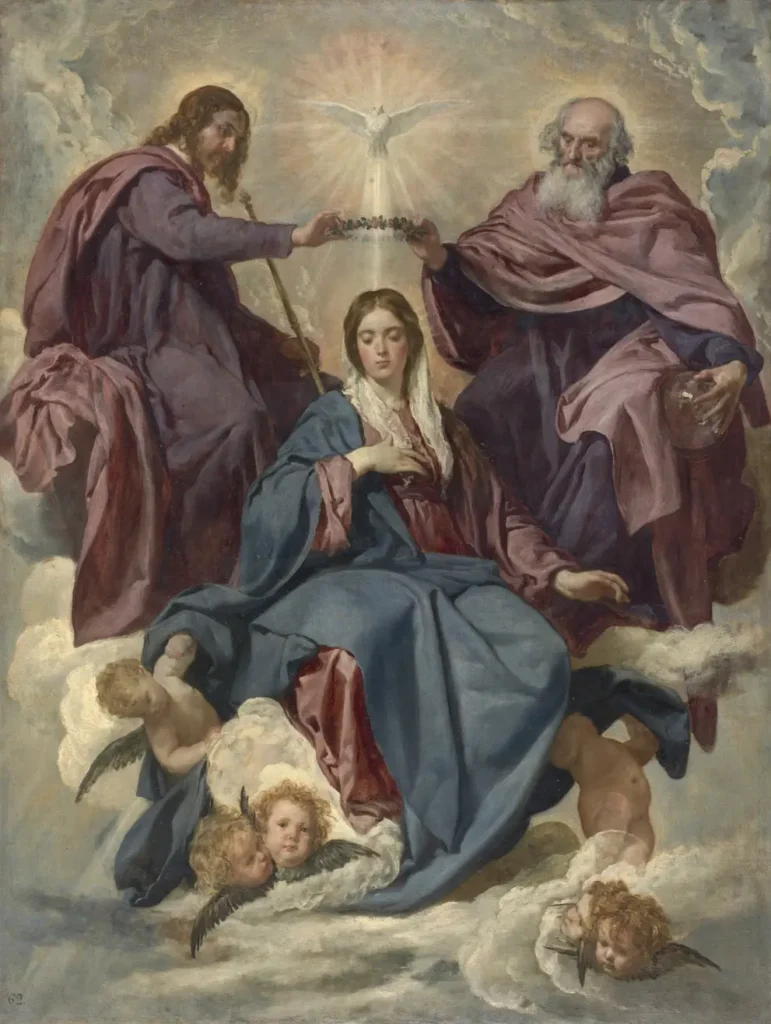
«Popular devotion invokes Mary as Queen. The Second Vatican Council, after recalling the Assumption of the Virgin “body and soul into the glory of heaven," explains that she was “exalted by the Lord as Queen of the universe, to be conformed more fully to her Son, the Lord of lords (cf. Ap "19, 16) and the conqueror of sin and death" (Lumen gentium , 59).».
Thus, Christians look with confidence to Mary, Queen of Heaven, and this not only does not diminish but, on the contrary, enhances their filial trust in her who is Mother in the order of grace.
«Moreover, the intercession of Saint Mary the Queen on behalf of humanity can be fully effective precisely by virtue of her glorious state following the Assumption. This is highlighted very well by Saint Germanus of Constantinople, who believes that this state ensures Mary’s intimate relationship with her Son and makes her intercession on our behalf possible. Addressing Mary, he adds: Christ wished “to have, so to speak, the closeness of your lips and your heart; in this way, He fulfills all the desires you express to Him when you suffer for your children, and He does, with His divine power, everything you ask of Him" ( Homily »1).".
«We can conclude that the Assumption not only fosters Mary’s full communion with Christ, but also with each one of us: she is at our side, because her glorious state allows her to accompany us on our daily earthly journey. We also read in Saint Germain: “You dwell spiritually among us, and the greatness of your care for us reveals your communion of life with us" ( Homily 1). »Rather than creating distance between us and the Virgin Mary, Mary’s glorious state fosters a constant and caring closeness. She knows everything that happens in our lives, and she sustains us with maternal love through life’s trials.”.
John Paul II (20th–21st centuries). Address at the general audience, July 23, 1997.
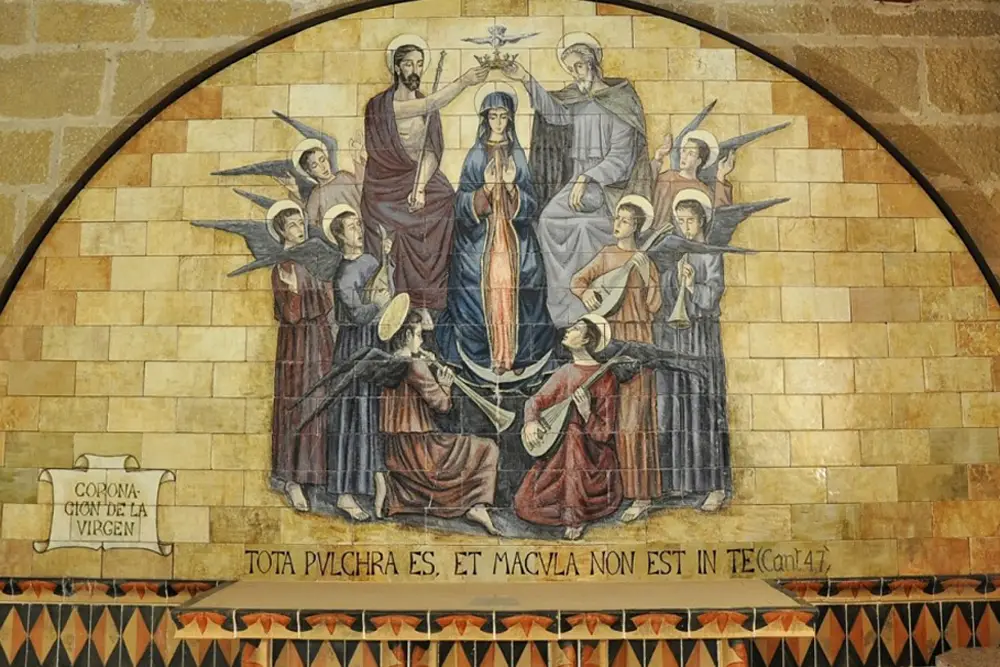
«You are all beautiful, and there is no blemish in you. —You are a garden enclosed, my sister, my bride, a garden enclosed, a sealed fountain.—” Come: you will be crowned . —Come: you will be crowned (Ct 4, 7, 12, and 8).
»If you and I had had the power, we would have made her Queen and Lady of all creation as well.".
»A great sign appeared in the sky: a woman with a crown of twelve stars on her head. —Clothed with the sun. —The moon at her feet ( Ap 12:1). Mary, the spotless Virgin, made amends for Eve’s fall: and with her immaculate foot, she has crushed the head of the infernal dragon. Daughter of God, Mother of God, Bride of God.
»The Father, the Son, and the Holy Spirit crown her as Empress of the Universe.".
»And the angels pay him homage as vassals... and the patriarchs and the prophets and the apostles... and the martyrs and the confessors and the virgins and all the saints... and all sinners—and you and me.».
Saint Josemaría Escrivá (20th century). Holy Rosary, Fifth Glorious Mystery.
Sources used: opusdei.org Gospel for August 22: Blessed Virgin Mary, Queen y Saint Mary, Queen: Praying with Saint Josemaría
 carf@fundacioncarf.orgLandline: +34 914 029 082Mobile: +34 638 078 51145 Conde de Peñalver Street.