Important dates of St. John Paul II

St. John Paul II, the traveling Pope, left an indelible mark on the history of the Catholic Church and the entire world. In order to understand the magnitude of his pontificate and his person, we must be familiar with the most important dates in the life of St. John Paul IIThe Pope's pontificate, those key moments that marked his path from his native Poland to the Holy See. On October 16, we commemorate the anniversary of the beginning of his pontificate back in 1978.

Join us in this chronological journey through the life of this great saint who inspired the creation of the Pontifical University of the Holy Cross in Rome, where more than a thousand seminarians, diocesan priests and religious men and women from all over the world are trained each year, who then return to their countries of origin to train others.
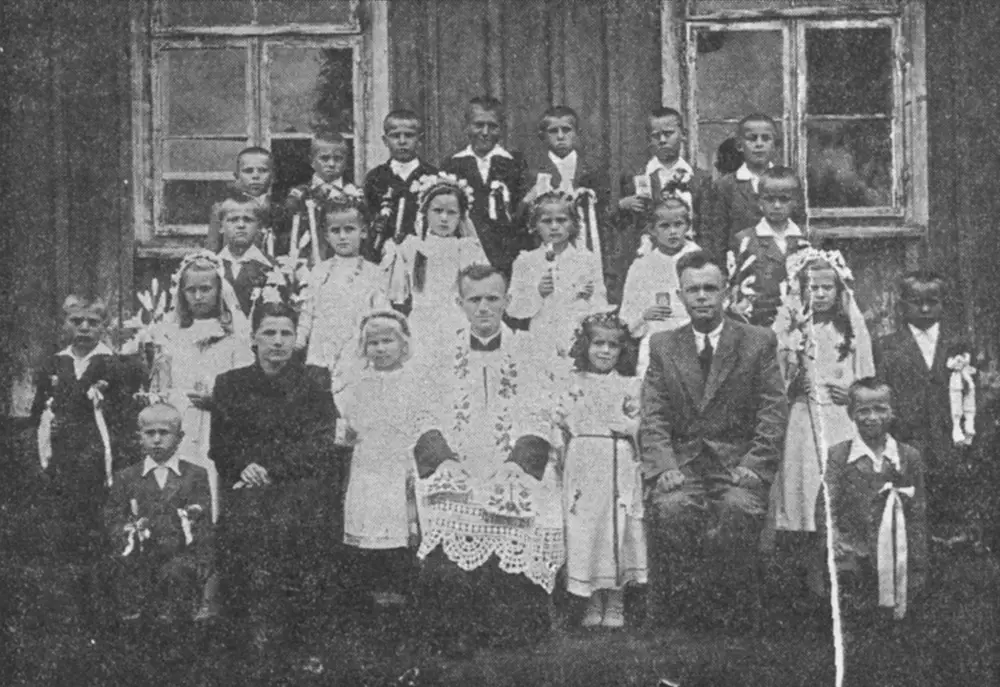
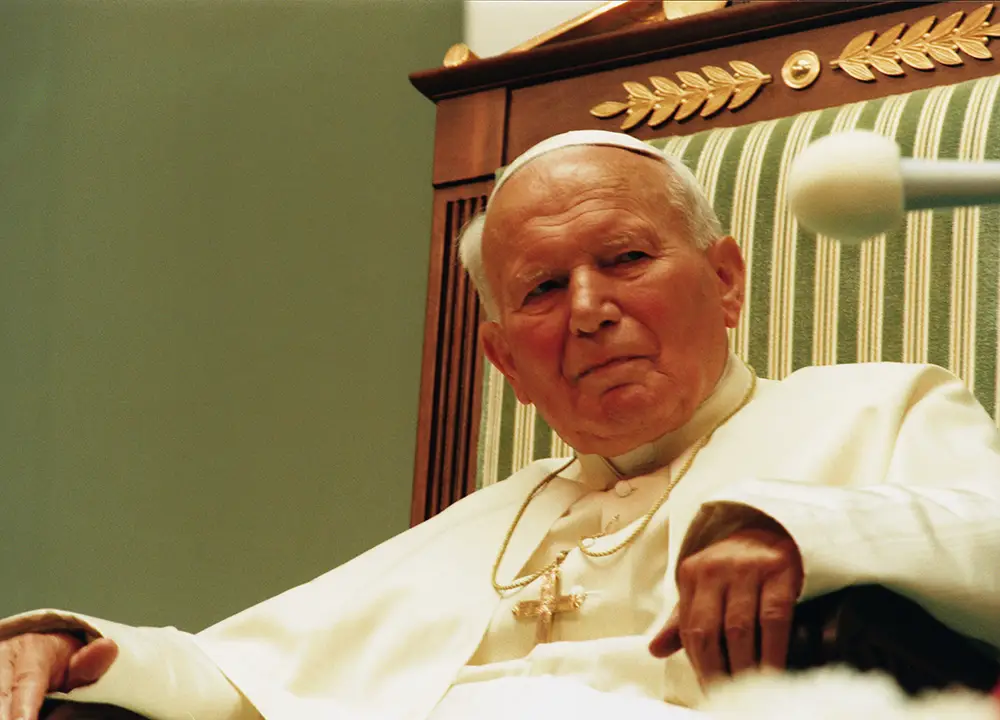
Karol Wojtyła como sacerdote en Niegowić, Polonia, 1948. Fechas más importantes de san Juan Pablo II.
Karol Wojtyła as a priest in Niegowić, Poland, 1948.

Early years and the priesthood

The life of Karol Wojtyła, the first name of St. John Paul II, was marked from the beginning by the great events of the 20th century and by a very difficult childhood. His youth was forged between the Nazi occupation and the subsequent Soviet domination of Poland, experiences that profoundly shaped his character and his faith.

To delve deeper into these early years, we recommend this video that summarizes his life:

John Paul II, a pontificate that changed lives

The election of a non-Italian cardinal surprised the world and marked the beginning of one of the longest and most significant pontificates in history, lasting 26 years, 5 months and 18 days. The most important dates of the pontificate of St. John Paul II are numerous and of great significance, some of which are highlighted below:

John Paul II during his visit to the Polish Parliament, 1999.

Apostolic journeys

In his almost 27 years of pontificate John Paul II made a total of 240 trips on the five continents: 104, outside Italy; and 146, carried out in Italy. If we translate this into kilometers: 1,247,613 kilometers, or 3.24 times the distance from the Earth to the Moon. The circumference of the Earth is about 40,075 km, this distance is equivalent to 31.13 laps to the planet.

In this video we leave you some of his most significant moments and gestures:

The last years of a saint

The last years of his life were marked by Parkinson's disease, which he bore with a fortitude that touched the world. Despite his physical limitations, he continued his mission to the end.

Encyclicals of great theological content

Here is a list of the encyclicals that St. John Paul II published during his pontificate, 14 in total. It includes the Latin name, the main theme and the year of publication:

Title (Latin)SubjectAyear of publication
1. Redemptor HominisJesus Christ, Redeemer of man. The centrality of man in the mystery of Redemption.March 4, 1979
2. Dives in MisericordiaThe Divine Mercy of God the Father.November 30, 1980
3. Laborem ExercensHuman labor and the social question (90th anniversary of Rerum Novarum).September 14, 1981
4. Slavorum ApostoliIn commemoration of Saints Cyril and Methodius, Apostles of the Slavs.June 2, 1985
5. Dominum et VivificantemThe Holy Spirit in the life of the Church and the world.May 18, 1986
6. Redemptoris MaterThe Blessed Virgin Mary in the life of the Church.March 25, 1987
7. Sollicitudo Rei SocialisThe Social Concern of the Church (20th anniversary of Populorum Progressio).December 30, 1987
8. Redemptoris MissioThe permanent validity of the missionary mandate.December 7, 1990
9. Centesimus AnnusThe social question, one hundred years after Rerum Novarum.May 1, 1991
10. Veritatis SplendorFundamentals of the moral teaching of the Church.August 6, 1993
11. Evangelium VitaeThe value and inviolability of human life.March 25, 1995
12. Ut Unum SintOn ecumenical commitment.May 25, 1995
13. Fides et RatioOn the relationship between faith and reason.September 14, 1998
14. Ecclesia de Eucharistia vivitThe Eucharist in its relationship with the Church.April 17, 2003

To know the most important dates of St. John Paul II immerses us in the life of an essential figure for understanding the 20th century; a man who lived and brought the Gospel to every corner of the planet with a message of hope, love and the defense of human dignity.


The gift of tears

Men are often ashamed to cry and shed tears; and it is a pity that this ancestral taboo that considers crying appropriate only for women still stands.

Perhaps in a subconscious area of the manly soul, Cervantes' enumeration of man's good crying still weighs too heavily: "For three things it is lawful for a prudent man to weep: the first, because he has sinned; the second, to obtain pardon for sin; the third, because he is jealous: tears do not speak well of a grave face." 

In my opinion, Don Miguel fell very short in this list of reasons for crying, perhaps because he failed to see that crying is one of the most sublime outpourings granted to us by our ancestors. Creator. He knows very well that a man needs to unburden his spirit at least as much as a woman does.

don de llorar ernesto juliá

We all cry, some more than others, it is true, but all of us: young and old, men and women, sick and healthy, conservative, backward, progressive, etc. Who does not weep at the death of a mother, sheds tears of joy at the birth of a child; who faces the attack of the enemy without flinching, sheds tears of despair and frustration at the betrayal of a friend.

And who has not wept peacefully when he kissed his elderly mother again after many years? Perhaps in those moments he has savored tears as a gift of God's tenderness towards human beings. 

Tears open doors

There is perhaps no gesture more endearingly human and divine as tears, than the very same Jesus ChristGod and true, lived in the death of his friend Lazarus. The Apostles also shed tears, and I dare say that there has not been a saint who has not wept.

Tears open the doors of those narrow prisons in which every human being feels imprisoned from time to time. What other recourse is there when faced with the death of an innocent child; when suffering an injustice that we are unable to repair; when faced with the rebellion of a child; when suffering from a completely unforeseen illness; when faced with the sudden madness of a loved one?

The shame of crying

Many people may be embarrassed to be seen crying by others, as if a tearful face is a humiliating manifestation of weakness, a sign of immaturity, or an inability to cope with certain life events.

I don't find Jacinto Benavente's comment very happy. regarding the different circumstances in which a man and a woman cry: "Men, he says, almost always cry alone; women cry only when they have a friend at their side who can wipe away their tears". And he is not happy, simply because every human being who cries wants to be consoled, although perhaps few are aware that the only one who can console them in the depths of their soul is God: this is what men and women thought, whom, throughout my life, I have found crying alone in a corner of a church.

Smiling after crying

"A life in which not a tear falls is like one of those deserts in which not a drop of water falls; it only breeds snakes". Castelar's comment, even with its good dose of romanticism, is still accurate. 

Only those who know how to cry, do not hate, do not bear grudges, do not feed desires for revenge.He manages to unleash the joy of his spirit with a serene smile.

Smiling after crying is like a rainbow, a symbol of peace, of serenity. And, on the contrary, not knowing, or not wanting to cry already has a hint of a curse, a condemnation to be cruel, and to never forgive. It is one of the misfortunes that can occur in the life of a man, of a woman.


Ernesto Juliáernesto.julia@gmail.com

Originally published in Religion Confidential.

The 108 Eucharistic miracles of St. Carlo Acutis

With his actions and his conduct, the already declared saint, represents a model of a young man who knows how to follow with courage and firmness the path indicated by the Lord, despite the difficulties without ceasing to lead a life close to Jesus.

The life project of St. Carlo Acutis, considered the millennial saint, was to live with Jesus, for Jesus and in union with Jesus. His life was not to dedicate it to vain things, but to give it to God, placing all his projects in his hands.

The life of this young Italian saint, leaves as fruit a work on the Eucharistic miracles for all Christians with which he manages to bring Jesus to the whole world through the Internet. He made, almost unwittingly, a contribution to the evangelizing work of the Church around the Holy Eucharist and the real presence of Jesus in it.

Blessed Carlo Acutis is an authentic witness that the Gospel can be fully lived by an adolescent. His brief existence, destined to the goal of the encounter with Jesus, is an example for Christian youth..

milagros eucarísticos carlo acutis
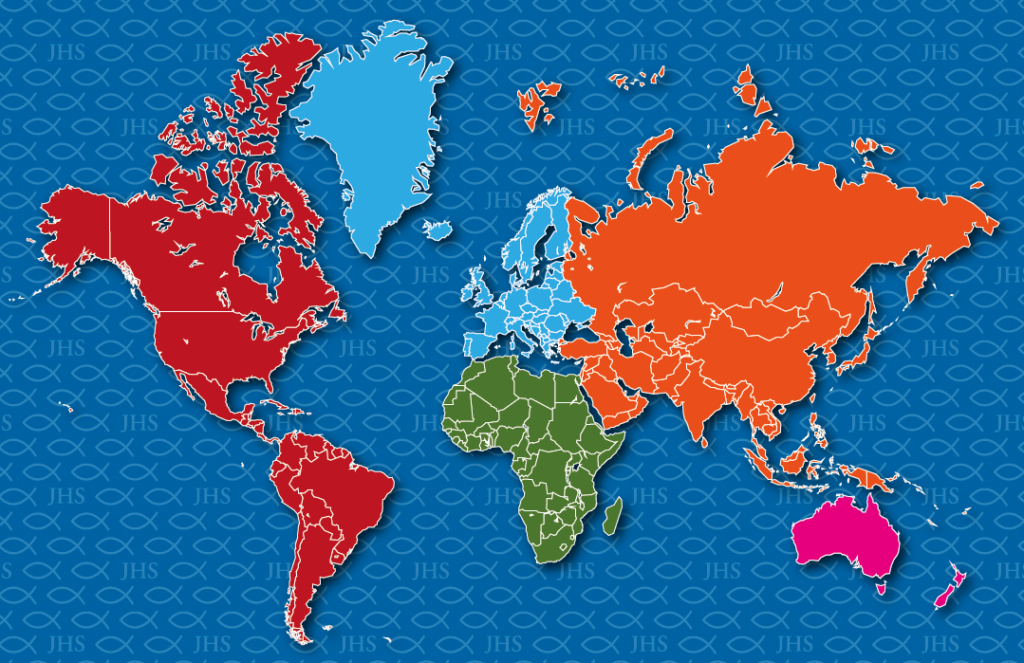
Map with the 163 panels created by saint Carlos Acutis

The exhibition on the Eucharistic miracles of St. Carlo Acutis

Carlo Acutis is known as Patron Saint of the Internet because he was able to use the new communication techniques to transmit the Gospel and to communicate Christian values.

In addition, he conducted research, compilation and design work that resulted in the creation of 163 panels where photographs and historical descriptions of Eucharistic miracles are shown. in different centuries and in the world.

In this way the exhibition on the Eucharistic miracles of Saint Carlo Acutis which has already toured many countries around the worldHe has visited more than 500 parishes in Italy and more than ten thousand parishes in other countries with translations in different languages.

With a a wide variety of photographs and historical descriptions, the Eucharistic miracles exhibition, the that have occurred over the centuries in different countries and that have been the subject of major events that have recognized by the Catholic Church. By means of the panels, the millennial saint gets us to virtually visit the places where these miracles occurred.

St. Carlo Acutis has a message for today's youth: life in Christ is beautiful and must be lived in fullness. Eternal realities are authentic and we are immersed in them more than we think.

"Everyone is born an original, but many die as photocopies." In order not to die as a photocopy, Carlo Acutis drinks from the source of the sacraments, which for him are the most powerful means to grow in Christian virtues. 

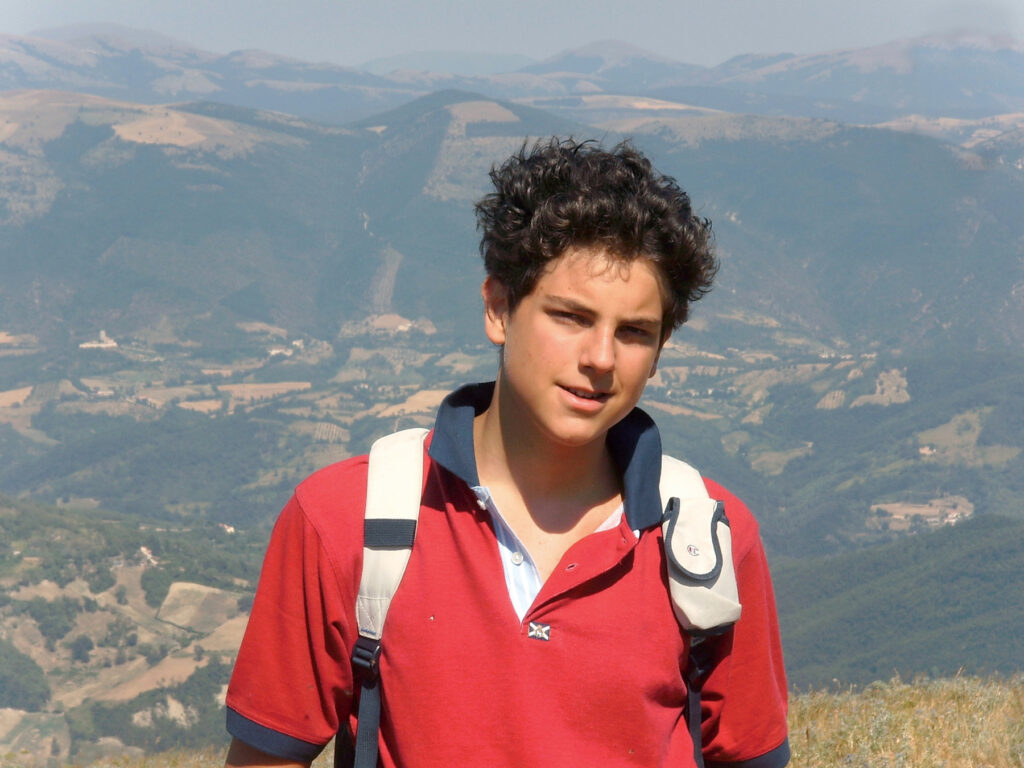
El joven san Carlo Acutis en una foto al aire libre con un paisaje de montañas al fondo, vistiendo un polo rojo y una mochila.
Carlo Acutis (1991-2006), the "cyber-apostle of the Eucharist," whose upcoming canonization will make him St. Carlo Acutis.

What are Eucharistic miracles?

The Eucharistic miracles are prodigious interventions of God. which are intended to confirm faith in the real presence of the body and blood of the Lord in the Eucharist.

During the liturgy of the Eucharist, the most important moment of the Catholic Mass is the Consecration of the bread and wine that will be transformed, through the words of the priest, into the body and blood of Christ.

This marvelous transformation, in the most important part of the Mass, takes the name of transubstantiation, that is, the change of one substance for another, cannot be experienced at all by the senses, only faith assures us of this marvelous transformation. It changes the substance without changing the accidents.

The Eucharistic miracles seek to confirm this faith, which is based on the words of Jesus: what looks like bread is not bread and what looks like wine is not wine.

In the Eucharistic miracles, flesh and blood are indeed seen, or one without the other depending on the miracle.

The purpose of these wonders is to demonstrate that we should not look for the external appearance (bread and wine), but for the substance, the true reality of things, which is the flesh and blood of Jesus Christ God our Lord.

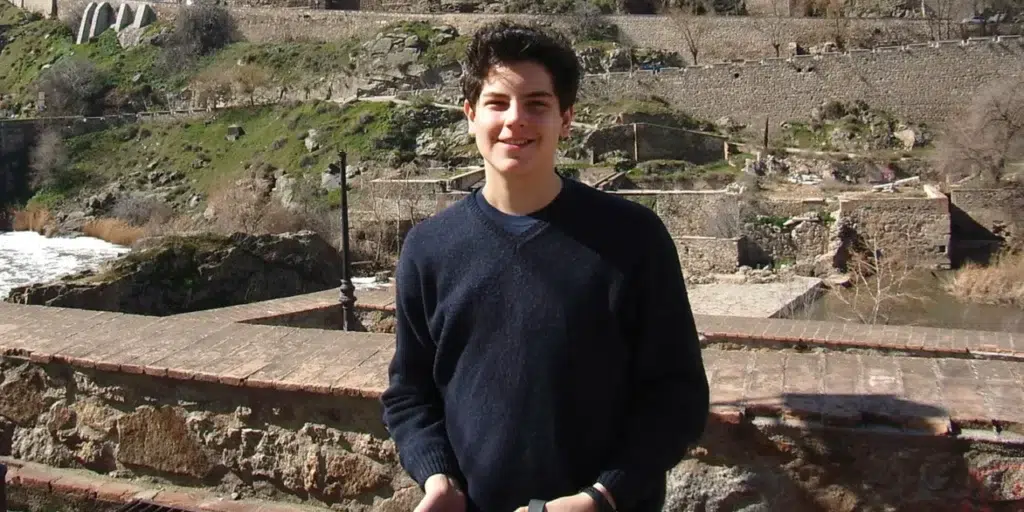
Fotografía del adolescente san Carlo Acutis sonriendo a la cámara en un entorno histórico, con un puente de piedra y un río al fondo, durante un viaje.
St. Carlo Acutis in an image that reflects his simplicity and the joy of a young man of our time.

Brief biography of St. Carlo Acutis

This young saint died in October 2006, at the age of 15, of acute myeloid leukemia, leaving in the memory of those who know his life a deep admiration for his witness of Christian life.

From a very early age, Carlo showed a great attraction for the Eucharist, he was a normal boy. He carried out different apostolic works.

He played the saxophone, played soccer and had fun with video games. But he did it all with an absolutely special harmony, thanks to his great friendship with Jesus.

He was a great connoisseur of the computer world. His knowledge ranged from computer programming to film editing, website creation, digital newspapers, and he used it for his apostolate.

His devotion grew daily thanks to Communion; he participated fervently in Holy Mass and prayed before the Blessed Sacrament.

Carlo's love for the Eucharist and the Virgin Mary were the pillars of his life. The Virgin Mary was his confidant and he never ceased to venerate her, praying the Holy Rosary and dedicating to her his sacrifices in the form of renunciations.

This is how he lived Carlo AcutisIn intimate friendship with Jesus and in his constant presence, he understood that an authentic spiritual life was necessary for effective missionary action. When he was diagnosed with leukemia, he offered his sufferings "for the Lord, the Pope and the Church".

As of April 6, 2019, the mortal remains of Carlo rest in the Sanctuary of the Despoilment of Assisi. Pope Francis named him blessed on October 10, 2020. And on September 7, 2025, Pope Leo XIV proclaimed him a saint, together with Pier Giorgio Frassati.

Canonization of St. Carlo Acutis

Acutis considered the millennial saint is canonized together with Pier Giorgio Frassati on September 7th 2025 in St. Peter's Square by Pope Leo XIV, accompanied by thousands of people.

If you were not able to see his canonization, you can now watch it through the following video:


Faustina Kowalska, Apostle of the Divine Mercy

In the history of the Catholic Church, few twentieth century figures have had such a profound and universal impact as saint Faustina Kowalska. This Polish nun, Apostle of the Divine Mercy, canonized in the year 2000

He received his message directly from Jesus Christ through a series of mystical revelations. His confessor obliged him to write down all the revelations in what is known as the Diary of Divine Mercy.

The first years

Helena Kowalska was born in 1905 in the village of Głogowiec, Poland, into a poor and pious peasant family. From a very young age, she felt a strong inclination towards the spiritual life. At the age of seven, she already sensed in her soul the call to the consecrated life.

Her parents were initially opposed due to the family's precarious economic situation. During her adolescence, she worked as a servant to help her family and save for her dowry, a common requirement at the time for entering a convent.

Despite the difficulties, the call of God was insistent. At the age of 18, faced with the refusal of her parents, she decided to give herself to the vagaries of life in order to silence the call of Grace. Precisely with her sister Josephine, when everyone was enjoying themselves and having a good time, she was not capable, she suffered and felt great sadness.

This episode was decisive for her vocation. She had a vision of the suffering Jesus who asked her: "Helena, my daughter, how long will you make me suffer, how long will you deceive me? This moment marked a point of no return.

She abandoned everything and, following this divine impulse, went to Warsaw to look for a convent that would accept her. After being rejected by several congregations, she was finally admitted into the Congregation of the Sisters of Our Lady of Mercy in 1925, where she adopted the name of Sister Maria Faustina of the Blessed Sacrament.

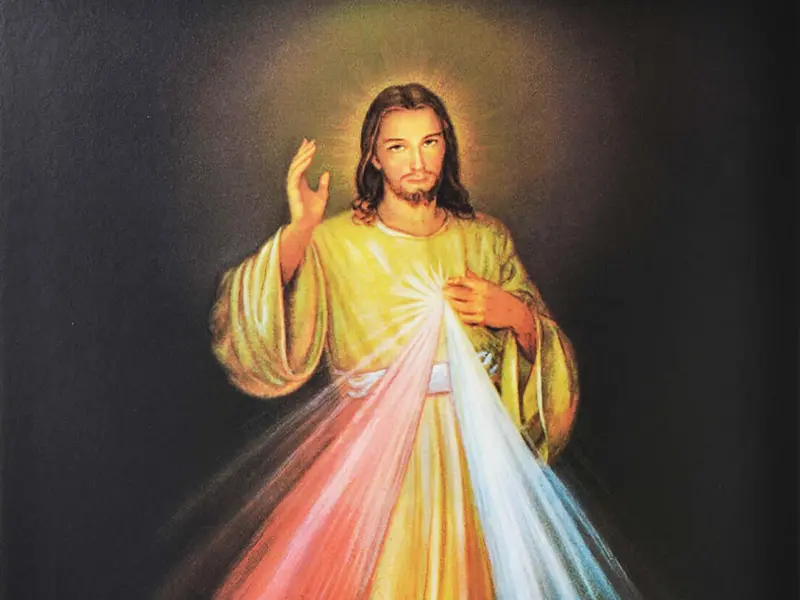
Imagen de Jesús de la Divina Misericordia de Santa Faustina Kowalsk

The mission of the Divine Mercy Secretariat

In 1928 she took her vows as a nun and lived very few years as such, since she died on October 5, 1938, at the age of 33, of which 13 years were spent in the convent. The life of Saint Faustina Kowalska like nun was apparently ordinary and simple. She performed with humility and diligence the simplest tasks: cook, gardener, doorkeeper, for she was warned that she would enter there as a lay sister and that, because of her low level of schooling, she might not reach higher levels in the order.

However, in the secret of her cell and of her heart, a mystical life of unprecedented depth was developing. Jesus appeared to her and entrusted her with a mission: to be the apostle and secretary of His Divine Mercy.

The core of her mission is found in her Diary, which her confessor obliged her to write with the simplicity of a person who barely received any academic training because of her extreme poverty. The manuscript of more than 600 pages meticulously recorded Jesus' words, visions and spiritual experiences.

In these revelations, Christ asked him to paint an image of Him as He appeared to him, with two rays emanating from His heart, one red and the other pale, symbolizing the blood and water shed on the Cross. Under the image was to be the inscription: "Jesus, I trust in You". Jesus told her that he wanted the image of the Divine Mercy to be "solemnly blessed on the first Sunday after Easter; that Sunday will be the feast of mercy".

This image, known today as the Divine Mercy, is one of the most recognized Christian icons in the world. Jesus also taught Sister Faustina the Chaplet of Divine Mercy, a prayer to implore mercy for the whole world, and asked her to establish the first Sunday after Easter as the Feast of Mercy.

This devotion was not a simple addition to popular piety, but an urgent reminder to a world mired in conflict and despair that God's greatest attribute is His infinite mercy.

A humble life

The service life humble of saint Faustina Kowalska was not limited to her prophetic mission. Her spirituality was deeply rooted in sacrifice and self-offering for the salvation of souls. She offered her sufferings, both physical-she suffered from tuberculosis for years-and spiritual, in union with the Passion of Christ. She understood that service to others and love of neighbor were the most authentic manifestation of devotion to Divine Mercy.

His obedience to his superiors and his spiritual director, Blessed Michael Sopoćko, was exemplary. Despite the doubts, misunderstandings and difficulties he encountered, even within his own congregation, he persevered with unwavering trust in the will of God. It was precisely his confessor, Sopoćko, who indicated to him that he should write a Diary with all the revelations that Jesus was making to him.

His life reflects how God chooses the humble to carry out his greatest works, demonstrating that holiness does not lie in doing extraordinary things, but in doing ordinary things with extraordinary love.

Faustina told Sopoćko about the Divine Mercy image, and in January 1934, he introduced her to the artist Eugene Kazimierowski, also a professor at the same university, where her confessor was teaching Pastoral Theology.

Divine Mercy

The Journal of saint Faustina Kowalska has been translated into dozens of languages and has guided countless people into a deeper relationship with God. Devotion to the Divine MercyThe company was decisively driven by St. John Paul II -who called her the great apostle of Mercy in our times, has spread throughout the Church. Today, its message resounds in a world wounded by division and sin, God's Mercy is the only refuge and the only hope.

On April 18, 1993, the Feast of Divine Mercy (second Sunday of Easter), John Paul II declared Sister Faustina Blessed in front of a crowd of Divine Mercy devotees in St. Peter's Square in Rome.

Maria Faustina Kowalska was canonized on April 30, 2000.The Holy Father presided over the canonization ceremony, the second Sunday of Easter, which the Catholic Church also calls Divine Mercy Sunday. The Holy Father presided over the canonization ceremony before a large crowd of devotees.

The life of this humble nun Polish teaches us that a service lifelived in faith and trust, can transform the world. St. Faustina reminds us that, no matter how great our weaknesses or sins, God's loving heart is always open to welcome us with his infinite mercy.


October 4, St. Francis of Assisi

The October 4the universal Church looks at the figure of St. Francis of Assisi. Known as the Francesco d'Assisinicknamed il poverello d'Assisi (the poor man of Assisi), his life is an invitation to rediscover the joy in simplicity and unconditional love for Christ through the poverty. He was noted for his love for others, his detachment and his eagerness to reform the Church. He would never forget the words he heard in a dream in Spoleto: "....¿Why do you persist in seeking the servant instead of the Lord?"

His life took a new direction, guided by the constant desire to know what the Lord might be calling him to. Prayer and contemplation in the silence of the lands of Umbria led him to embrace as brothers the lepers and vagabonds for whom he had always felt disgust and repulsion.

Giovanni Pietro Bernardone

Born Giovanni di Pietro Bernardone, he always had in his heart the desire to accomplish great undertakings; this is what at the age of twenty prompted him to leave, first to the war between Assisi and Perugia and then to the Crusades. Son of the rich cloth merchant Pietro di Bernardone, and of Pica, a lady of the Provençal nobility, he was born in 1182 and grew up in the comforts of family and worldly life. When he returned from the harsh experience of war, ill and agitated, he was unrecognizable to everyone. Something had deeply marked his mood, something different from the experience of the conflict.

Young Francis lived a life of opulence, dreaming of the glory of being a knight. However, God had other plans. After experiences as a prisoner of war and a serious illness, his restless soul began to search for a higher purpose. The turning point came at the hermitage of San Damiano, when, praying before a crucifix, he heard a voice saying to him: "Francis, go and repair my Church which, as you see, is in ruins". This call would mark the rest of his life and his vocation of service to the Church.

The embrace of poverty

St. Francis understood that call in a literal way at first, dedicating himself to physically repairing hermitages. However, he soon realized that the Lord was asking him for something much more profound: a spiritual renewal of the Church through example. To this end, he stripped himself of everything. In a public and dramatic act, he renounced his father's inheritance, stripped himself of his luxurious clothes and consecrated himself to God, embracing what he called his Lady Poverty, in front of Bishop Guido.

This was not a poverty miserable or sad, but a free choice. For St. Francis of Assisithe poverty was the most direct way to imitate Christ, who "though he was rich, yet for our sake he became poor" (2 Cor 8:9). Possessing nothing, Francis became completely dependent on the Providence of God, finding immense joy in the little he had.

This attitude is a model for the Christian life and, in a particular way, for the priestly vocation, which demands a detached heart in order to serve God and souls without any attachment. The formation of priests continues to draw from this spirit of detachment.

With the most disadvantaged

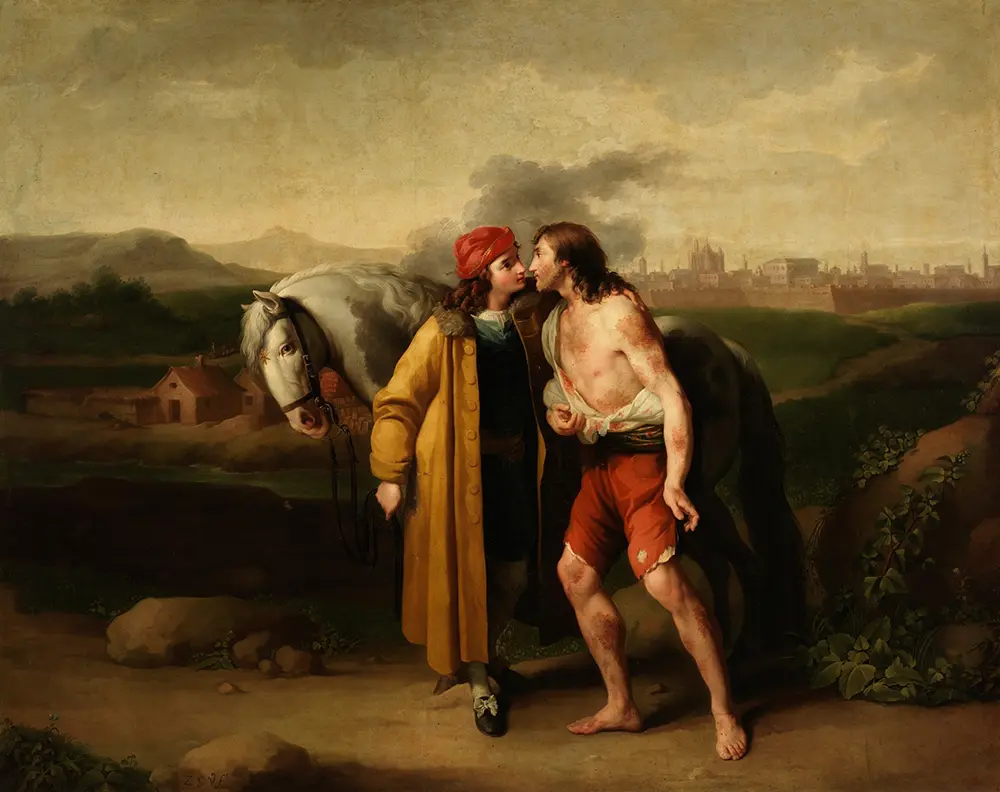
His love for the poverty of Jesus led him to encounter Him in the most disadvantaged. The famous episode of the embrace of the leper symbolizes his total conversion: where before he felt repulsion, now he saw the suffering face of Christ. This love for the poor and the marginalized is a dimension of the service to the Church that every baptized person, and especially the priestis called to live.

San Francisco de Asís abraza con compasión a un hombre con lepra, superando su propia repulsión.
St. Francis embracing a leper, Oil on canvas, 217 x 274 cm. by Zacarías Joaquín González Velázquez y Tolosa ©Museo Nacional del Prado.

Rebuilder of the Church

The mission to repair the Church finally materialized in the founding of the Order of Friars Minor (Franciscans), a fraternity that lived the Gospel. sine glossathat is, without interpretations that would soften its radicalism.

Later, together with St. Clare, he also inspired the female branch of the Poor Clares. The example of Francis and his friars was a spiritual revival at a time when the Church was suffering in the midst of luxury and power struggles.

They demonstrated that true reform does not come from destructive criticism, but from personal holiness and obedience. A priestThe way to holiness, as tradition teaches us, can transform an entire parish. The road to that holiness is a constant struggle that lay and consecrated people must follow.

Love for Creation

St. Francis of Assisi is also remembered for his deep love for Creation. In his famous Canticle of the Creatures, he praises God through "brother sun", "sister moon" and "sister our mother earth".

He was not an ecologist in the modern sense, but a mystic who saw in every creature the imprint of the Creator. Everything spoke to him of God, from a bird to a wolf.

This theological vision of nature, which inspired the encyclical Laudato Si' of Pope Francis, invites us to care for the world as a gift received from God.

Example for priests

The life of St. Francis of Assisi culminated in the gift of the stigmata, the signs of Christ's Passion imprinted on her own body for two years, a visible sign of her complete identification with her Lord.

His legacy teaches us that true joy is not in having, but in being. He reminds us of the importance of humility and obedience to the Church, even as we yearn for her reform.

For each priest, St. Francis is a mirrora call to live a new life poverty to preach the Gospel with life more than with words, and to love every soul as a gift from God. As St. Josemaría Escrivá taught in his book Loving the Churchlove for the Church passes through humble service and total dedication.

Embracing the Cross

On the evening of October 3, 1226, when Sister Death came to visit him, he went out to meet Jesus with joy. He died on October 4, lying on the bare earth, faithful to his beloved poverty until the end.

Let us ask St. Francis of Assisi to intercede for us so that, like him, we may know how to strip ourselves of everything that separates us from God and joyfully embrace the daily cross, rebuilding the Church from the only place possible: our own heart.


October, month of the rosary

During the month of October we put special care in the recitation of the Holy Rosary. The October 7 we celebrate Our Lady of the Rosary. This powerful weapon, as St. Josemaría called it, bears many fruits of conversion and peace. "The Holy Rosary is a powerful weapon. Use it with confidence and you will marvel at the result" (The Way, 558).

Contemplation of the mysteries of the life of Jesus, through the four parts of the Rosary, brings us closer to Our Lord and, through the intercession of Our Mother, to all those who need us. Always include in your petitions seminarians, diocesan priests and religious that they may be very holy.

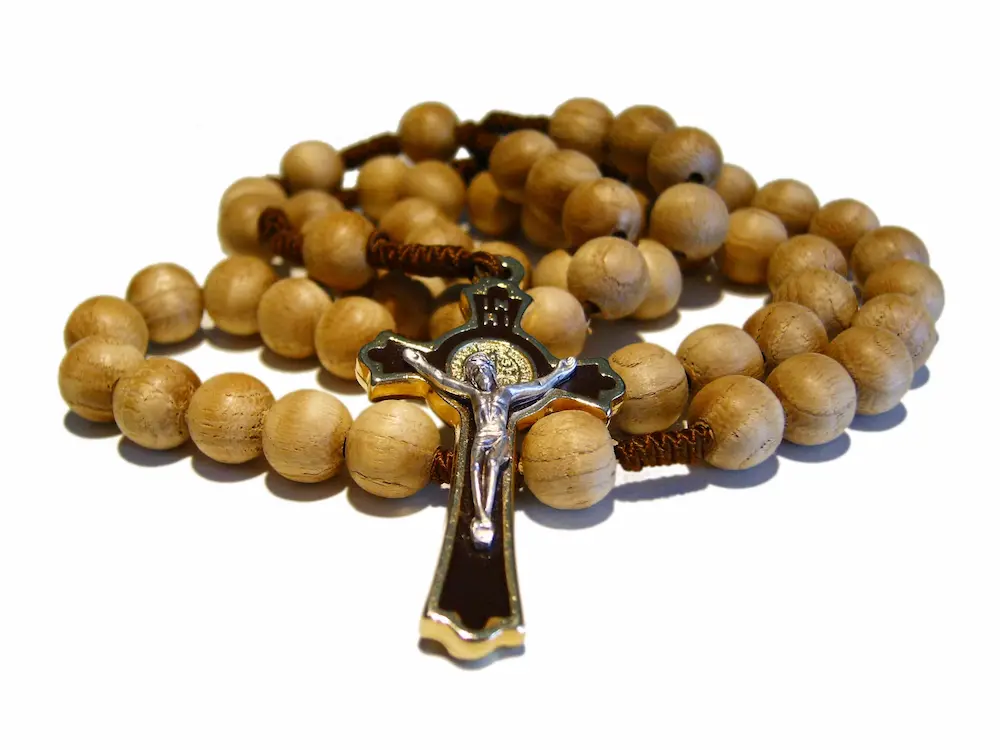
This month, the Church invites us to take the Rosary beads and contemplate the mysteries of our faith with the best of guides: our Mother.

Origins of the Rosary

The recitation of the holy Rosary took a long time to take shape as we know it today. It was not devised at a specific moment in time, but was is the result of a long evolution. It all probably started in the tenth century. In the year 910, Saint Benedict founded the Cluniac Order. She attached great importance to communal choral prayer. He wanted his abbeys to be a foretaste of the heavenly Jerusalem, where saints and angels are continually singing praises to God and interceding for all human beings (cf. Rev 5:9; 14:3; 15:3).

It is estimated that the origin of the Rosary goes back to the birth of the Hail Mary in the 9th century, as a prayer to honor Mary, the Mother of God, and that the Rosary originated in the order of St. Benedict and spread through the action of the Dominicans.

The devotion to the Holy Rosary has deep roots in the history of the Church. The feast of Our Lady of the Rosary, celebrated every October 7, was instituted by Pope St. Pius V to commemorate the victory of the Christian fleet at the Battle of Lepanto in 1571. A victory directly attributed to the intercession of the Virgin Mary, invoked through the massive recitation of the Rosary throughout Christendom.

In Lourdes, Fatima and many other apparitions of Our Mother. The Virgin Mary has always urged us to pray the Rosary uninterruptedly: for the conversion of sinners, for the end of evil in the world, etc.

But beyond its historical context, the Rosary is a school of prayer. It is not a simple repetition of Hail Marys, but a path of contemplation. At pray the RosaryWe can walk with Mary through the most significant moments of Jesus' life: the joyful, luminous, sorrowful and glorious mysteries. As St. Josemaría would say, the Rosary is "the prayer of the simple and the wise.

It is a constant dialogue, a "coming and going" of affections between a son and his mother, where we tell her our joys, sorrows and longings, while she takes us by the hand towards Jesus.

Guide for praying the Rosary

If you don't know how to do it, you can follow these steps to pray the Rosary to Our Mother the Virgin Mary.

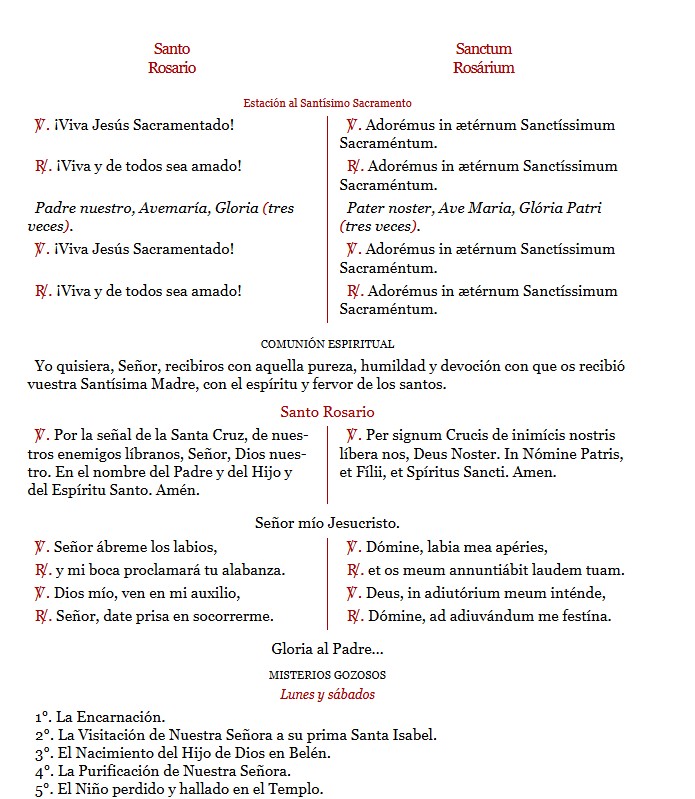
The Rosary may begin with the recitation of the Station to the Blessed Sacrament concluded with Spiritual Communion.

From there, we make the sign of the cross (different from making the sign of the cross -santifixion- because there are three crosses on the forehead, the mouth and the chest).

Subsequently, the first of the five mysteries to be contemplated that day is announced. On Mondays and Saturdays, the joyful mysteries are contemplated; on Tuesdays and Fridays, the sorrowful mysteries; on Thursdays, the luminous mysteries; and on Wednesdays and Sundays, the glorious mysteries. 

Each mystery is composed of an Our Father, ten Hail Marys and a Glory Be. After each mystery, we repeat: "Mary, Mother of Grace, Mother of mercy, defend us from our enemies and protect us now and at the hour of our death. Amen.

At the end of the five mysteries, the five mysteries of the day are prayed:

After the three Hail Marys, we begin the prayers of praise of the Litany of Our Lady of Laurel. After them, we recite one of the most ancient prayers to Our Mother: "Under your protection we take refuge, Holy Mother of God: do not despise the supplications that we address to you in our needs, but rather, always deliver us from all dangers, glorious and blessed Virgin". And the Rosary ends asking for:

Many people like to end with the Salve to the Virgin. According to the traditions of different places, to this structure for praying the Rosary are added some ejaculatories and prayers that express the variety of popular piety.

guia rezar rosario octubre mes del rosario
You can use this guide
St. Josemaría, a lover of the Rosary

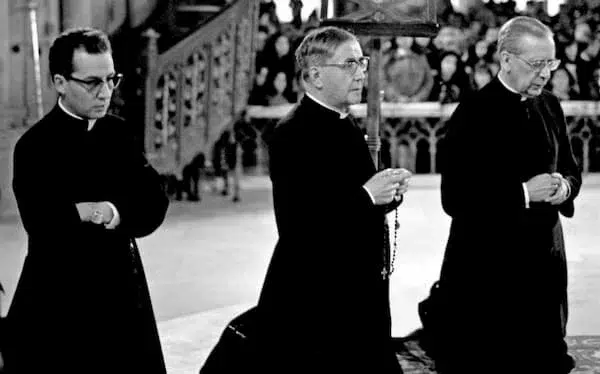
To understand this devotion, there are eloquent examples such as St. Josemaría Escrivá. His love for the Virgin was the driving force of his spiritual life and the Rosary was a fundamental part of his daily conversation with her. He did not see it as a pious obligation, but as a necessity of the heart.

In his book Holy Rosarywhich is not a theological treatise but a collection of contemplations written in a running order, St. Josemaría invites us to "immerse ourselves" in each scene of the Gospel. At pray the RosaryWe are not mere spectators; we are another character: the child who smiles at Jesus in the manger, the disciple who accompanies Christ in his pain, the friend who rejoices in his Resurrection.

San Josemaría reza el rosario con gran devoción

St. Josemaría called the rosary a "powerful weapon. With it, he said, we win the battles of the soul and the conversion of souls. This weapon is not of violence, but of love and trust. It is the weapon of perseverance, of inner peace and of the strength to face the difficulties of daily life, sanctifying work and ordinary duties. This vision converts the act of pray the rosary in a tool for the service to the Church from our own vocation.

To make of October, month of the RosaryIt is easier than it seems to make it a permanent habit in our lives. St. Josemaría teaches us that there is no need for extraordinary circumstances. We can pray it in the car, walking down the street, in a moment of rest at work, or, best of all, in the family. The family that prays together stays together, and the Rosary is the bond that unites the hearts of parents and children to the Immaculate Heart of our Mother Mary.

This profound love for the Virgin must be very special in the life of priests. A priest is first and foremost a alter ChristusAnd who better than Mary to form the heart of a priest in the image of her Son? She formed him in her womb, educated him in Nazareth and accompanied him to the Cross. For this reason, the rosary is an essential prayer for every seminarian and priest. It strengthens his priestly identity and unites him to the Mother of the High Priest. Supporting the formation of priests is to ensure that the Church has shepherds with a Marian heart.

The Virgin Mary is, as the Catechism of the Catholic Church defines her, the perfect pray-er, the figure of the Church. To go to her through the Rosary is to learn to pray as she did: with humility, faith and total surrender to the will of God.

Octubre, mes del rosario

A resolution for this month

What October, month of the RosaryLet it become not just a claim in the customs of the Catholic Church, but a lived reality. Inspired by the example of saints like St. Josemaría, let us take up our Rosary beads with enthusiasm. Let us make this prayer a daily appointment of love with our Mother. As Pope Francis has reminded us on many occasions, the Rosary is the prayer that always accompanies his life, the prayer of his heart. Pope Leo XIV has asked us to pray the Rosary in this month of October, especially for peace in Gaza and Ukraine and throughout the world.

Let us entrust to Our Lady our intentions, the needs of the world and, in a special way, let us pray for the holiness and perseverance of priests. We will discover that pray the rosary not only brings us peace, but makes us courageous apostles, capable of bringing the joy of the Gospel to every corner of the world. Because an authentic love for the Virgin always leads to a greater and more committed love for her Son and for the Church. Marian devotion, as the lives of so many saints teach us, is a pillar in the life of every Christian, a sure anchor that we can find in the example of Mary as a model for Christians.